三輪山平等寺
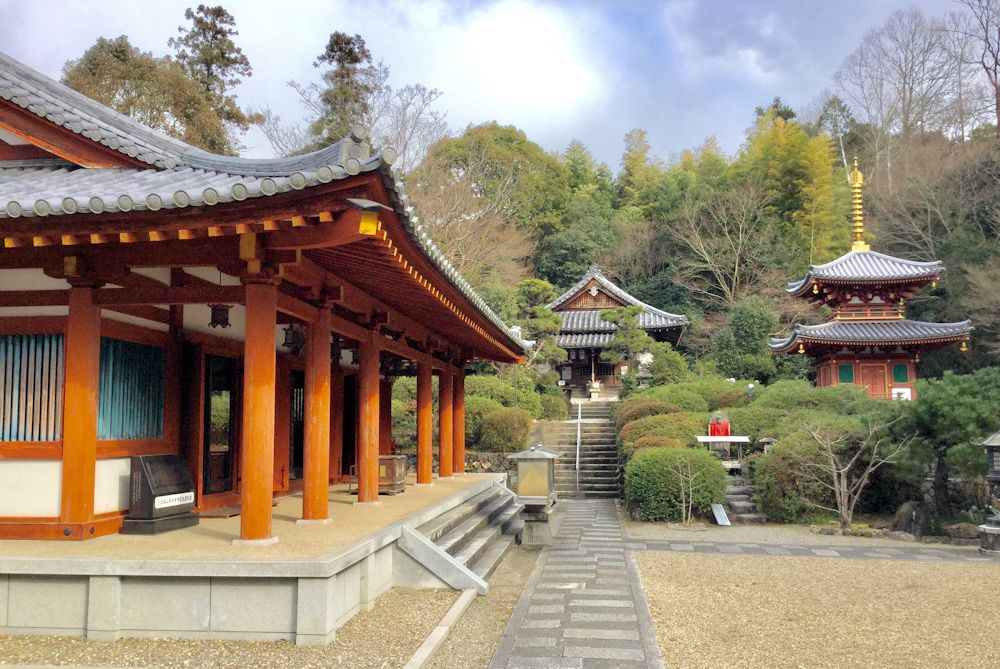
聖徳太子創建伝承
空海弘法大師 高野山以前平等寺に遍照院建立
慶円三輪上人 神仏両部を完成した中興祖
島津義弘公 関ヶ原の合戦後に平等寺に70日間滞在
Legend of Prince Shotoku's founding
Kukai, Kobo Daishi, established Henjo-in at Byodo-ji Temple before Mount
Koya
Keien Miwa Shonin, the restorer who completed both Shinto and Buddhist
practices
Shimazu Yoshihiro, stayed at Byodo-ji Temple for 70 days after the Battle
of Sekigahara
由緒 History
伝承によれば、聖徳太子の開基、慶円の中興とされている。『大三輪町史』は、平等寺以前の大三輪寺遍照院の存在から空海開基説の存在も述べている。
平等寺が前述資料に明確に現れてくるのは鎌倉時代以降であり、初見は「弥勒如来感応抄草」の1236(嘉禎2)年である。同書によれば慶円によって、三輪神社の傍らに真言灌頂の道場が建立され、その道場が「三輪別所」であった。この当時、平等寺が存在して「三輪別所」と呼称されており、その後比較的早い時期に「平等寺」という寺号で呼ばれることとなったことは確実であり、これが、現在史料で明確に確認できる最古の例である。
中興の祖、慶円禅観上人は三輪上人ともいわれ、『大三輪町史』には「慶円は、保延6年(1140)鎮西(九州)に生まれた。吉野の堯仁に師事して、醍醐金剛王流(真言宗)の奥義をきわめる。のち、安倍の崇敬寺に住み、三輪山平等寺にうつった。日々、三輪山で秘法を修めていたが、ある日、閼伽井(アカイ)のほとりで、三輪明神の影向(ヨウコウ)をうけ、神道灌頂之秘法(シンドウカンジョウノヒホウ)を授けられた。貞応2年(1223)1月27日、84歳で示寂した」と記されている。
鎌倉末期から明治の廃仏毀釈までは、三輪明神の別当寺の地位にたっていた。一方で、「大乗院寺社雑事記」には、興福寺が平等寺に御用銭を課していることが見られ、大和国の他の寺院同様、興福寺の末寺でもあった。また、同時に修験道を伝えていたことから、醍醐寺との関係も保持していた。そのため、内部に「学衆(興福寺大乗院)」と「禅衆(醍醐寺三宝院)」という、二つの僧侶集団が作られ、両者が共存する関係にあった。室町中期には、禅衆と学衆が激しく争ったことも、「大乗院寺社雑事記」には描かれている。
江戸時代には、興福寺の支配を離れ、真言宗の寺院となりつつも、修験道も伝えていた。平等寺は内供といって皇室の祈願をするお寺でもあり、朱印地の石高は80石。また、伽藍配置は、室町時代の絵図により知られる。それによると、三輪明神の南方に慶円上人開山堂のほか、行者堂・御影堂・本堂・一切経堂など、東西500m南北330mの境内地に本堂をはじめとする七堂伽藍のほか12坊舎が存在したことがうかがわれる。旧本堂跡地は現在地の300m東にあり、三輪の1番地である。
1600(慶長5)年9月15日の関ヶ原の戦いで島津軍は、徳川の軍勢の真っただ中を切り抜けて逃げ、軍勢はわずか80名になった。名張から一軍は京都に、一軍は大阪に、一軍は吉野に逃げ、島津義弘以下、第一家老の川上四郎兵衛はじめ本部隊の13名が平等寺に落ちのびた。義弘主従は11月28日までの70日間逗留し、住職から帰りの舟を買うお金、銀一貫目(約4キロ)を借り薩摩に帰還した。1600(慶長5)年11月28日付の借用証には、用立ての銀子は一貫目、借用の判人として、長谷場織部祐、川上久右衛門、町田源六、伊集院弥兵左衛門、本田主水祐、三原七右衛門、白浜三四郎、川上助七、川上四郎兵衛、喜入摂津守、旅庵、新納新八郎など重臣14名の名を連ねている。それから後の島津家は平等寺を大事にし、江戸時代の中頃には三間四面屋根紋付の護摩堂を一寄進で建立し、幕末までの300年間、毎年鹿児島米40石(153俵)とご祈祷料銀5枚を奉納した。
当時の平等寺は南都大乗院の末寺であるが、大峰勤行の寺院でもあって、高野山金剛峰寺と同格であった。醍醐の三宝院などの大峰入りに関して、たびたび大先達役を勤仕した。それで、後年江戸幕府の大峰参詣の代参を奉仕して、その御礼を献上するために1814(文化11)年江戸に下っている。その道中記事「御礼献上記」は現存している。薩摩の島津家の大峰入りに関しても例外ではなく、恒例の行事として奉仕していた。
1868(明治元)年、神仏分離の太政官布告が出される。これにより、1870(明治3)年には、平等寺は大御輪寺、浄願寺と共に三輪神社の神官が管理するにいたり、堂舎は破壊され、廃止となる。1959(昭和34)年の『大三輪町史』には、「三輪小学校北側の道を三輪山の方へ登って行く道を平等寺坂といい、この道を進んで翠松庵の横、大行事神社の前の坂道を登りつめると、平等寺跡がある。もと高野山の所管であったが、のちには奈良の大乗院の末流となった。いまから750年ほど前、僧慶円がこの寺に来て平等寺といい、大神神社の神宮寺のようになり、社僧は大神神社の式事を勤めた。境内の広さは南北328メートル、東西490メートルもあって、本堂は六間四面の瓦葺、本尊は聖徳太子御自作と伝える十一面観音秘仏であった。その他維摩堂・御影堂・上人堂・鐘楼などいろいろな建物があり、大智院・中之坊・常楽院・多楽院・吉祥院など九ヵ坊の僧房があった。明治元年神仏分離のとき、僧侶たちは還俗し、お寺はつぎつぎになくなって、現在はただその石垣ばかりが残っている。」「現在はその伽藍は存在せず、わずかに塔中の石垣のみが遺跡として存在する」と記されたが、実際には廃仏毀釈の直後、小西家より現境内地の寄進を受け、廃仏毀釈前の平等寺住職・覚信和尚と町内有志18名が塔頭の一部を境内に移し、本尊十一面観世音菩薩、三輪不動尊、慶円上人像、仏足石等を守り、曹洞宗慶田寺住職・梁天和尚が翠松庵の寺号を移し曹洞宗に改宗し法灯を護持した。
1977(昭和52)年、曹洞宗の寺院、「三輪山平等寺」として再興した。丸子孝法の16年間の托鉢によって現在は伽藍も復元されている。
1987(昭和62)年7月29日、1600(慶長5)年から387年経って、鹿児島から川上四郎兵衛一行が平等寺を参拝し、本堂にて島津義弘並びに藩士の追悼供養法要が厳修され、その折、島津義弘自作の薩摩琵琶「小敦盛」が奉納弾奏された。1987(昭和62)年年11月4日、島津氏第32代当主・島津修久の招待により第74代平等寺住職・丸子孝法が福昌寺跡の島津義弘並びに歴代藩主の墓前に参拝した。
The Historical Overview and Legends of Byodo-ji Temple
Origins and FoundersAccording to legend,
Byodo-ji Temple was founded by Prince Shotoku and later restored by the
monk Keien. However, the History of Omiwa Town (Omiwa Choshi) notes an
alternative theory that attributes the founding to Kobo Daishi (Kukai),
based on the prior existence of Omiwa-dera Henjo-in Temple before Byodo-ji.Byodo-ji
first appears clearly in historical records during the Kamakura period,
specifically in the 1236 text Miroku Nyorai Kanno Sho Sō. According to
this document, Keien established a training center for Shingon Esoteric
ritual initiations (Shingon Kanjo) adjacent to Miwa Shrine. This training
center was known as "Miwa Bessho." It is certain that the temple
existed at this time under the name Miwa Bessho and was renamed Byodo-ji
shortly thereafter. This stands as the oldest verifiable evidence of the
temple in existing historical documents.The restorer of the temple, Keien
Zenkan Shonin, was also known as Miwa Shonin. The History of Omiwa Town
records his life as follows:"Keien was born in Chinzei (Kyushu) in
1140. He studied under Jōnin of Yoshino, mastering the deepest secrets
of the Daigo Kongo-o lineage of Shingon Buddhism. He later resided at Sukei-ji
Temple in Abe before moving to Byodo-ji Temple on Mount Miwa. While performing
esoteric rituals daily on Mount Miwa, the Miwa Deity appeared to him by
the Akai (sacred well) and bestowed upon him the secret ritual of Shinto
Initiation (Shinto Kanjo). He passed away on January 27, 1223, at the age
of 84."Medieval Influence and Internal StructureFrom the late Kamakura
period until the anti-Buddhist movement (Haibutsu Kishaku) of the Meiji
era, Byodo-ji held the prestigious position of Betsutō (the head administrative
temple) of Miwa Shrine. Conversely, records from the Daijo-in Jisha Zojiki
show that Kofuku-ji Temple imposed official levies on Byodo-ji, indicating
that like many other temples in Yamato Province, Byodo-ji operated as a
branch temple of Kofuku-ji. Concurrently, because Byodo-ji transmitted
the teachings of Shugendo (mountain asceticism), it maintained close ties
with Daigo-ji Temple.As a result, two distinct groups of monks coexisted
within the temple: the Gakushu (scholastic monks affiliated with Kofuku-ji's
Daijo-in) and the Zenshu (ascetic monks affiliated with Daigo-ji's Sanbo-in).
The Daijo-in Jisha Zojiki chronicles intense conflicts that erupted between
these two factions during the mid-Muromachi period.During the Edo period,
Byodo-ji broke away from the control of Kofuku-ji and became an independent
Shingon sect temple, while continuing its Shugendo traditions. Designated
as an Naiku temple, it performed official prayers for the Imperial Court
and held a shogunal domain (shuinchi) yielding 80 koku of rice.The layout
of the grand complex is preserved in illustrations from the Muromachi period.
These maps reveal that south of Miwa Shrine, within a precinct measuring
500 meters east to west and 330 meters north to south, stood a complete
seven-building compound (Shichido Garan) alongside 12 monk residences.
This included the Main Hall, the Founder's Hall dedicated to Keien Shonin,
the Gyoja Hall, the Miei Hall, and the Issaikyo Hall. The original site
of the former Main Hall is located 300 meters east of the current location,
marked today as No. 1 Miwa.The Escape of the Shimazu ClanFollowing their
defeat at the Battle of Sekigahara on September 15, 1600, the Shimazu army
made a daring breakthrough directly through the center of the Tokugawa
forces. Their numbers dwindled to a mere 80 warriors. As they retreated
from Nabari, the forces split into groups heading toward Kyoto, Osaka,
and Yoshino. The lord Yoshihiro Shimazu, along with his chief retainer
Shirobe Kawakami and a core group of 13 retainers, fled to Byodo-ji Temple.Yoshihiro
and his retainers stayed at the temple for 70 days until November 28. To
secure their safe passage home, the chief priest lent them one kanme of
silver (approximately 4 kilograms) to purchase boats for their return to
Satsuma. A promissory note dated November 28, 1600, confirms this loan
of one kanme of silver. It bears the signatures of 14 high-ranking retainers,
including Oribenosuke Haseba, Kyuemon Kawakami, Genroku Machida, Yaheizaemon
Ijuin, Mondonosuke Honda, Shichimon Mihara, Sanjiro Shirahama, Sukeshichi
Kawakami, Shirobe Kawakami, Settsu-no-kami Kiire, Ryoan, and Shinhachiro
Niiro.In gratitude, the Shimazu family treated Byodo-ji with great reverence
for centuries. In the mid-Edo period, the clan fully funded the construction
of a Goma Hall, featuring a grand four-sided roof adorned with the family
crest. For 300 years until the end of the Edo period, the clan made an
annual offering of 40 koku of Kagoshima rice (equivalent to 153 sacks)
and five silver coins for prayer services.At the time, Byodo-ji was a branch
temple of the southern Daijo-in, but it also served as a primary training
temple for the Omine mountain pilgrimage, holding equal status with Kongobu-ji
Temple on Mount Koya. The temple frequently served as the Daisendatsu (grand
guide) for the Omine pilgrimages undertaken by Daigo-ji’s Sanbo-in. Consequently,
in 1814 (Bunka 11), temple representatives traveled to Edo to perform a
proxy pilgrimage on behalf of the Edo Shogunate and present their official
gratitude. The travel log of this journey, titled Orei Kenjoki (Record
of Offerings and Gratitude), survives to this day. The Shimazu clan of
Satsuma was no exception; Byodo-ji regularly guided their Omine mountain
pilgrimages as an established annual tradition.
The Meiji Crises, Modern Reconstruction, and the Revived Bond with the
Shimazu ClanThe Crisis of the Meiji Restoration (Haibutsu Kishaku)In 1868
(the first year of the Meiji era), the new government issued the Shinto
and Buddhism Separation Edicts (Shinbutsu Bunri Rei). As a result, by 1870
(Meiji 3), Byodo-ji—along with Daigorin-ji and Jogan-ji temples—was placed
under the strict control of Shinto priests from Miwa Shrine. The temple
buildings were demolished, and the temple was officially abolished.The
1959 edition of the History of Omiwa Town (Dai-Miwa Choshi) described the
tragic aftermath of this period as follows:"The path ascending toward
Mount Miwa from the north side of Miwa Elementary School is called Byodo-ji
Slope. Following this path past Suisho-an and climbing the slope in front
of Daigyoji Shrine leads to the former site of Byodo-ji Temple. Initially
under the jurisdiction of Mount Koya, it later became a branch temple of
Daijo-in in Nara. About 750 years ago, the monk Keien arrived at this temple
and named it Byodo-ji, transforming it into a shrine-temple (jinguji) integrated
with Omiwa Shrine, where the ritual monks (shasō) performed official shrine
ceremonies. The precincts spanned 328 meters north to south and 490 meters
east to west. The Main Hall was a tiled structure measuring roughly 11
meters on all four sides, enshrining the secret principal image of the
Eleven-Headed Kannon, which was said to have been carved by Prince Shotoku
himself. The complex contained various other structures, including a Vimalakirti
(Yuima) Hall, a Miei Hall, a Founder’s (Shonin) Hall, and a Bell Tower,
alongside nine sub-temples (bō) such as Daichi-in, Nakano-bo, Joraku-in,
Taraku-in, and Kissho-in. During the separation of Shinto and Buddhism
in the first year of Meiji, the monks were forced to return to secular
life, and the temple buildings vanished one after another. Today, only
the stone walls remain."The historical text claimed that "the
grand temple complex no longer exists, leaving only the stone walls of
the sub-temples as ruins." However, the actual chain of events immediately
following the anti-Buddhist movement proved more resilient. The Konishi
family donated the current temple grounds, allowing Priest Kakushin (the
chief priest before the persecution) and 18 local volunteers to successfully
relocate parts of the sub-temples into the new precincts. Through this
act, they preserved the principal image of the Eleven-Headed Kannon Bodhisattva,
the Miwa Fudo Myoo, the statue of Keien Shonin, and the Buddha’s Footprint
Stone. To keep the Buddhist flame alive, Priest Ryōten, the chief priest
of Keiden-ji Temple, transferred the temple name "Suisho-an"
to the site and converted the lineage to the Soto Zen sect.Modern Reconstruction
and Re-establishing the Sacred NameIn 1977 (Showa 52), the temple was officially
resurrected under its historical name, "Miwa-san Byodo-ji," as
a temple of the Soto Zen sect. Thanks to the relentless efforts of Priest
Kaho Maruko, who spent 16 years traveling the country for mendicant fundraising
(takuhatsu), the grand temple buildings and complex have been fully restored
to their former glory today.The Revived Bond with the Shimazu ClanOn July
29, 1987 (Showa 62)—exactly 387 years after the historic event of 1600—descendants
of Shirobe Kawakami and a delegation from Kagoshima visited Byodo-ji Temple.
In the Main Hall, a solemn memorial service was conducted for the repose
of Lord Yoshihiro Shimazu and his loyal samurai retainers. During this
ceremony, a dedication performance was played on the Satsuma biwa (a traditional
lute) titled Ko-Atsumori, an instrument originally crafted by Yoshihiro
Shimazu himself.Later that year, on November 4, 1987, at the personal invitation
of Nobuhisa Shimazu, the 32nd head of the Shimazu clan, Priest Kaho Maruko
(the 74th chief priest of Byodo-ji) visited the former site of Fukusho-ji
Temple in Kagoshima. There, he paid his respects and offered prayers before
the graves of Yoshihiro Shimazu and the successive lords of the Satsuma
Domain, cementing a centuries-old bond that endures into the modern era.