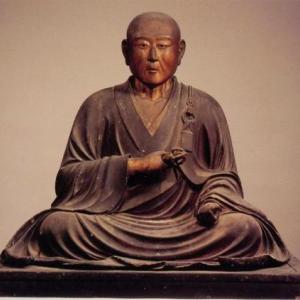
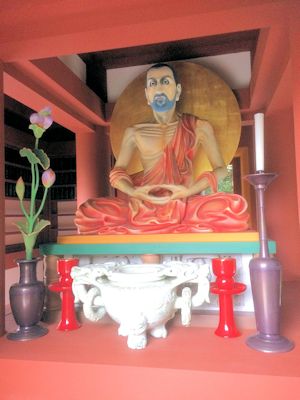
釈迦如来真像(成道の釈迦))
お釈迦様がお悟りになられて後6年、釈迦国を訪れになられました。父である浄飯王は、仏陀となったお釈迦様の姿を見、画家に命じて絵を書かせました。(ロンドン博物館秘蔵)本堂の釈迦像は、丸子孝法老師が28歳の時はじめて模写されたものです。
The True Portrait of Shakyamuni Buddha (The Buddha Attaining Enlightenment)
Six years after achieving enlightenment, Shakyamuni Buddha returned to
visit his homeland, the Shakya Kingdom. Upon seeing his son, who had now
become the fully awakened Buddha, his father, King Suddhodana, was deeply
moved and commanded a royal court painter to capture his true likeness.
(The original masterpiece is now securely preserved in the archives of
the British Museum in London).The statue of Shakyamuni Buddha enshrined
in the Main Hall is a physical recreation based on a detailed replica that
Priest Koho Maruko meticulously painted at the age of 28, marking the very
first time he copied this sacred portrait.
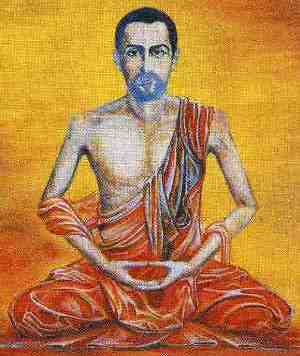
釈迦如来真像(成道の釈迦)
三輪山古図にもとづき800年ぶりに再建された二重塔(釈迦堂)の本尊。丸子孝法住職が描いた釈尊41才画像をもとに仏師が彫ったもので、台座には釈迦八相図がみごとに彫刻されています。
The True Portrait of Shakyamuni Buddha (The Buddha Attaining Enlightenment)
This is the principal image enshrined within the Two-Story Pagoda (Shaka-do
Hall), which was reconstructed for the first time in 800 years based on
ancient maps of Mount Miwa (Miwa-san Kozu).The statue was crafted by a
master Buddhist sculptor, modeled precisely after a portrait of the Buddha
at age 41 painted by Chief Priest Koho Maruko. The pedestal of the statue
features a magnificent and intricate carving of the Shaka Hasso-zu (the
Eight Phases of the Buddha's Life), which beautifully depicts the key milestones
of Shakyamuni Buddha's life from his birth to his passing into Nirvana.
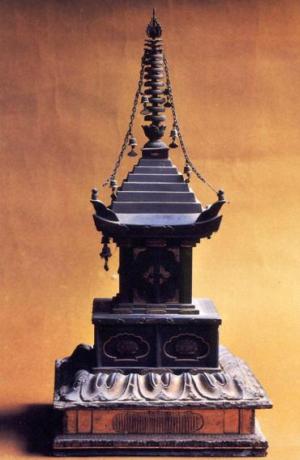
仏舎利塔
鎌倉時代、奈良の春日大社より平等寺に移された仏舎利塔で、お釈迦様の仏舎利を納めたものです。寺宝として大切に守られてきました。
The Buddhist Reliquary Pagoda (Busshari-to)
Dating back to the Kamakura period, this sacred reliquary pagoda was transferred
from the grand Kasuga Taisha Shrine in Nara to Byodo-ji Temple. It houses
the sacred Busshari (the holy ashes and bone relics of Shakyamuni Buddha).
For centuries, it has been deeply revered and carefully preserved as one
of the temple's most precious and historic treasures.
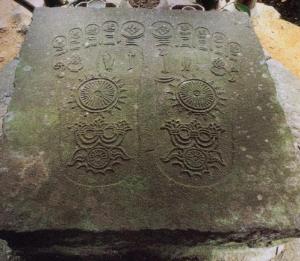
仏足石
お釈迦様亡き後、ストゥーパ(塔)と仏足石が信仰の中心になりました。三十二相のうちの七つの徳相が刻まれ、お釈迦様の教えが広まり人々に安らぎを与えることを意味しています。古くより、平等寺仏足石として有名です。
The Buddha’s Footprint Stone (Bussokuseki)
Following the passing of Shakyamuni Buddha, and before the creation of
human Buddha statues, sacred stupas (pagodas) and these footprint stones
served as the central focuses of early Buddhist faith.
This stone is engraved with seven of the Sanjuni-so (the 32 auspicious
physical characteristics of the Buddha). These sacred markings symbolize
the spread of the Buddha's teachings across the world to bring lasting
peace and spiritual comfort to all people. Since ancient times, it has
been widely renowned and revered as the "Byodo-ji Buddha's Footprint
Stone."
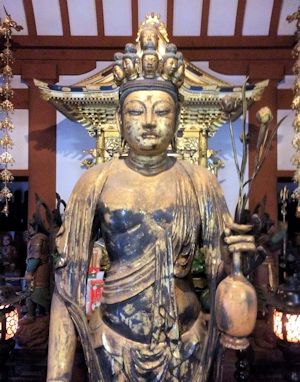
本尊十一面観世音菩薩
The principal image eleven-faced Kanzeon Bodhisattva.
当寺開山・聖徳太子が平和を祈願して御自ら作られた本尊。現在の本尊は素朴な尊顔や衣文の彫りから平安時代初期から中期頃に復元したものといわれています。左手に水瓶らしきものを持っていますが、当初は蓮の花が有った花瓶と考えられます。下半身に比べ、上半身と顔のバランスが大きいことから、平安時代以前の仏像の特徴をよく表しています。寛文、延宝(1661~1681)の頃の島津綱貴の書翰には当時の平等寺の全貌が記されており、その覚書の最初には「一、平等寺本堂 六間四面 屋根瓦葺 本尊 十一面観音秘仏聖徳太子御自作」と記されています。また、1771(明和8)年5月の三輪山平等寺の御朱印には中心に「本尊阿弥陀如来 三輪山平等寺」と書かれており、さらに1808(文化5)年に伊能忠敬が奈良を測量したあとに寺社を参詣し宝物を拝観した記録には「三輪山平等寺 眞言宗 開基聖徳太子 中興開山慶圓上人 本堂 六間四面 本尊 阿弥陀 安阿弥作」と記されています。時代によっては阿弥陀如来様が本尊とされ、十一面観音様は秘仏としてまつられていたのかもしれません。
The Principal Image: Eleven-Headed Kanzeon Bodhisattva (Juichimen Kanzeon
Bosatsu)
This sacred image is the central object of devotion at Byodo-ji, originally
hand-carved by the temple’s founder, Prince Shotoku, to pray for lasting
peace.Based on the rustic, serene expression of the face and the specific
style of the drapery lines carved into the robes, the current statue is
believed to be a restoration dating from the early to mid-Heian period.
The deity holds an object resembling a water jar in the left hand, though
historical analysis suggests this was originally a flower vase holding
a sacred lotus blossom. The upper body and head are slightly larger in
proportion to the lower body, a prominent stylistic characteristic of Japanese
Buddhist sculpture created prior to or during the Heian period.A historical
letter written by the lord Tsunataka Shimazu during the Kanbun and Enpo
eras (1661–1681) describes the entire layout of Byodo-ji at that time.
The very first line of his memorandum clearly notes: "Item: Byodo-ji
Main Hall, measuring approximately 11 meters on all four sides with a tiled
roof. The principal image is the secret Buddha, the Eleven-Headed Kannon,
hand-carved by Prince Shotoku."Interestingly, an official vermilion-seal
document (Goshuin) from Byodo-ji dated May 1771 displays the inscription
"Principal Image: Amida Nyorai, Miwa-san Byodo-ji" at its center.
Furthermore, in 1808 (Bunka 5), the famous cartographer Tadataka Ino, after
surveying the Nara region, visited local temples to view their sacred treasures.
His logs record: "Miwa-san Byodo-ji Temple, Shingon Sect. Founded
by Prince Shotoku, restored by Keien Shonin. Main Hall measures 11 meters
on all four sides. Principal image: Amida, crafted by An'ami (Kaikei)."These
records strongly suggest that during certain eras, Amida Nyorai was publically
revered as the main deity, while the Eleven-Headed Kannon was strictly
preserved and hidden from public view as a sacred Hibutsu (Secret Buddha).
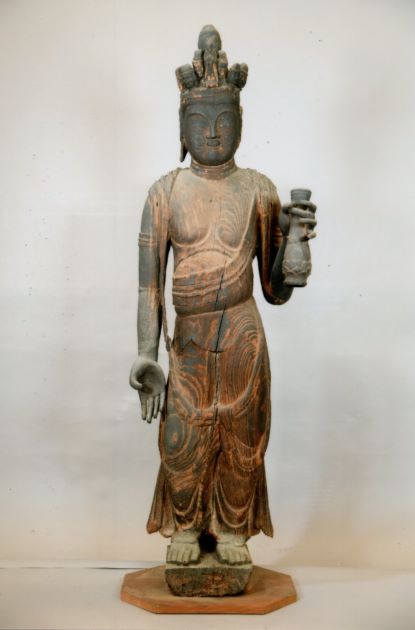
本尊前立十一面観世音菩薩像(復元)
江戸時代に性亮玄心(しょうりょうげんしん)により平等寺の遍照院が聖林寺に移されました。そして、明治の神仏分離令の際に、大御輪寺から本尊の十一面観音が聖林寺に移管されたと伝えられています。また、神仏分離令時の平等寺住職・覚信和尚の御子孫、勝井茂雄氏よりは、十一面観音様は廃仏毀釈の折に取り壊された本堂の瓦礫に埋もれて雨ざらしになっていたのを大八車に乗せて平等寺から聖林寺に運ばれたとも伝え聞いています。さらに、十一面観音様には光背がありましたが廃仏毀釈以前の平等寺本堂は昭和に再建した本堂よりも9m高く、光背も含めた十一面観音様がまつられる大きさであったので、廃仏毀釈前に光背を外して大御輪寺に移され、それから聖林寺へ運ばれたという説もあります。現住職の発願により、1982(昭和57)年に本堂が復興再建された折に聖林寺の倉本弘玄住職より十一面観音様に関する文化財の資料を頂き、文化財の専門家のご協力のもと、樹齢1500年の桧材により一木で復元されました。
The Replicated Image: The Front-Facing Eleven-Headed Kanzeon Bodhisattva
Statue (Mae-dachi Juichimen Kanzeon Bosatsu)
During the Edo period, the monk Shōryō Genshin relocated the Henjō-in sub-temple
of Byodo-ji to Shōrin-ji Temple. According to common historical accounts,
during the Meiji government’s separation of Shinto and Buddhism, the famous
Eleven-Headed Kannon statue (now a designated National Treasure) was officially
transferred from Daigorin-ji Temple to Shōrin-ji.However, an alternative
oral history has been passed down by Shigeo Katsui, a direct descendant
of Priest Kakushin, who served as the chief priest of Byodo-ji during the
anti-Buddhist movement (Haibutsu Kishaku). According to this account, the
magnificent Eleven-Headed Kannon was actually left exposed to the elements,
buried underneath the debris of Byodo-ji's demolished Main Hall. It is
said that local protectors carefully salvaged the statue from the rubble,
placed it onto a large wooden handcart (daihachiguruma), and transported
it directly from Byodo-ji to Shōrin-ji.Furthermore, there is a historical
theory regarding the statue’s original halo (kohai). The original Main
Hall of Byodo-ji prior to the Meiji era was 9 meters taller than the current
hall rebuilt in the Showa era, making it spacious enough to house the massive
Kannon statue together with its grand halo. It is theorized that before
the height of the anti-Buddhist destruction, the halo was detached, temporarily
moved to Daigorin-ji, and subsequently transported to Shōrin-ji.Driven
by a solemn vow of the current chief priest, the Main Hall was successfully
reconstructed in 1982. On this occasion, Priest Kōgen Kuramoto, the chief
priest of Shōrin-ji, provided priceless archival materials regarding the
original Kannon statue. With the dedicated cooperation of cultural property
experts, this front-facing replica was meticulously carved from a single
piece of a 1,500-year-old Japanese cypress (hinoki) tree, restoring the
sacred icon to its historic home.
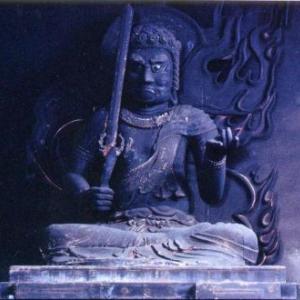
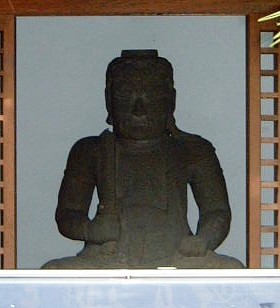
三輪不動明王 (大日大聖不動明王)
伝大三輪寺遍照院開山・空海弘法大師ご自作 明治の廃仏毀釈以前は、不動堂に四体の不動明王が並んでいました。
Miwa Fudo Myoo: The Great Wrathful Deity (Dainichi Daisho Fudo Myoo)
This sacred image of Fudo Myoo (the Immovable King of Light) is traditionally
said to have been hand-carved by Kobo Daishi (Kukai), the revered founder
of the Shingon sect and the legendary founder of Dai-Miwadera Henjo-in
Temple.Historical records show that prior to the anti-Buddhist movement
(Haibutsu Kishaku) of the Meiji Restoration, four distinct statues of Fudo
Myoo were enshrined side by side within the Fudo-do Hall, standing as a
powerful testament to the temple's rich esoteric lineage.
波切不動明王
弘法大師空海の信仰されたお不動様で、人間の煩悩を断ち切る力を与えてくれます。
Namikiri Fudo Myoo (The Wave-Cutting King of Light)
This statue of Fudo Myoo (the Immovable King of Light) was an object of
deep personal devotion for the great monk Kobo Daishi (Kukai). The deity
is revered for bestowing practitioners with the spiritual strength to sever
and overcome earthly desires, delusions, and emotional attachments (bonno).
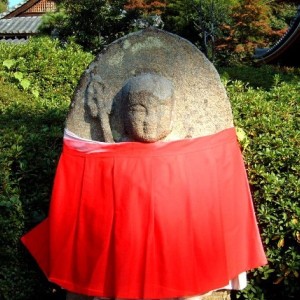
熱とり地蔵
吉野朝時代、僧善教が大和の熱病平癒を祈願して彫られたお地蔵様。熱病や、ありとあらゆる病魔を退散すると伝えられています。
Netsutori Jizo (The Fever-Relieving Jizo Bodhisattva)
Dating back to the Yoshino-cho period (the Northern and Southern Courts
Shogunate era), this sacred statue of Jizo Bodhisattva was hand-carved
by the monk Zenkyo to pray for the eradication of epidemic fevers sweeping
through Yamato Province. Legend states that this compassionate deity holds
the divine power to banish debilitating fevers and expel all forms of illness
and malevolent plagues from the body.
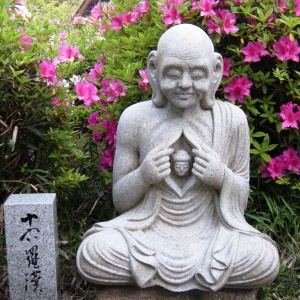
十六羅漢像
十六羅漢とは、釈迦の命により、この世に長くいて正法を守り、衆生(しゅじょう)を導く16人の大阿羅漢のことです。平成22年4月に鎌倉の寺尾家から寄贈いただきました。
Statues of the Sixteen Arhats (Juroku Rakan-zo)
The Sixteen Arhats are 16 great enlightened disciples (Arhats) who were
commanded by Shakyamuni Buddha to remain in this earthly world for ages
to protect the true Buddhist teachings (Dharma) and guide all living beings
(Shujo) toward salvation. These statues were generously donated to the
temple by the Terao family of Kamakura in April 2010.
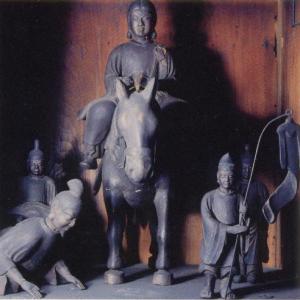
聖徳太子像
聖徳太子とお供の方、賊軍の大将綾葛が、太子に帰依している大変珍しいお像です。明治の廃仏毀釈で一度失われましたが昭和57年本堂再建の折に三輪の奥山家より還ってきました。
The Statue of Prince Shotoku (Shotoku Taishi Zo)
This is an extremely rare and unique group of statues that depicts Prince
Shotoku alongside his attendants and Ayazura, the defeated general of a
rebel army who surrendered and converted to become a deeply devoted follower
of the Prince.Although this sacred masterpiece was lost during the anti-Buddhist
movement (Haibutsu Kishaku) of the Meiji era, it was safely preserved for
generations by the Okuyama family of Miwa and was miraculously returned
to the temple in 1982 when the Main Hall was rebuilt.
聖徳太子立像
奈良県シルクロード博覧会の年に、タイムカプセルを納めて建立されたブロンズ像です。平等寺の前身である大三輪寺をお開きになられた聖徳太子の在りし日のお姿をかいまみることができます。
The Standing Statue of Prince Shotoku (Shotoku Taishi Ritsuzo)
This bronze statue was erected in commemoration of the Nara Silk Road Exposition
(1988), with a historic time capsule sealed and buried beneath it. The
monument offers visitors a glimpse into the lifetime appearance of Prince
Shotoku, the legendary founder of Dai-Miwadera Temple, which was the historical
predecessor of modern Byodo-ji.
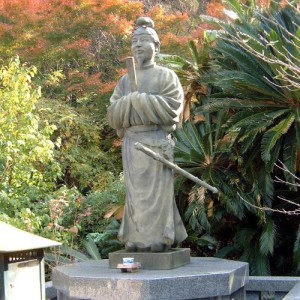
中興開山慶円禅観大和尚 (平安・鎌倉時代)
日本国の神仏両部を成して三輪流神道を起こした高僧。三輪清浄・一相平等なることを発願し、1204年三輪山平等寺と改めになられました。慶円さまは1140年にお生まれになりましたが、その時すでに眉間に琥珀色の肉が出ていて、お釈迦さまの白毫大丈夫の相のようであったと伝えられています。成人して自ら「三界は元より空なり、萬法は幻の如し、栄華の世相なんぞ常に保つべけんや」といわれたそうです。和州(奈良)の吉野の堯仁阿闍梨について修行し安倍寺で修行を重ね、三輪山遍照院にうつられ、1204年、差別のない平等の世の中を願求して『三輪山平等寺』と改号されたのです。慶円さまは、生まれつき慈悲の心あつく、すべての人を救う神仏のような思いをおもちのお方でありました。まだ夜もあけぬ朝、平等寺のみ仏にお供えするあかいの渓水を汲みにいかれた時、三輪明神が貴女の姿になって石上にあらわれ、慶円さまと問答をなさるのです。慶円さまが「あなたさまのお名前をおきかせ下さい」と尋ねると、貴女は、「この山の杉です」とお答えになり、自ら「おのづから いわきをおのが すがたにて かげはずかしき みむろやまかな」と詠ぜられ、御身を消されたといわれます。この31文字の和歌が平等寺のご詠歌として伝えられております。慶円さまは、仏教各宗のご開山と同格に、わが国最初の仏教史書「元亨釈書」(ゲンコウシャクショ)に出ている高僧で、そのご一代が明らかであります。三輪山平等寺中興の祖として、また三輪流神道の祖として、正法の興隆につくされた慶円さまは、1223年正月27日遷化され、84歳の尊いご一代に幕をおとされました。
The Restorer and Founder: The Venerable Monk Keien Zenkan Daiwajo (Heian
to Kamakura Period)
The Venerable Keien was a high-ranking Buddhist monk who integrated Shinto
and Buddhism in Japan to found Miwa-ryu Shinto (Miwa-style Shinto). Praying
for the spiritual purity of Miwa and the ultimate equality of all phenomena,
he officially renamed the temple "Miwa-san Byodo-ji" in 1204.Keien
was born in 1140. Legend states that at the moment of his birth, a distinctive
amber-colored mark was already visible between his eyebrows, resembling
the Byakugo (the white tuft of hair or urna on the forehead of Shakyamuni
Buddha, which signifies great wisdom). Upon reaching adulthood, he is said
to have declared: "The three realms of existence are originally empty,
and all phenomena are like illusions. How can the fleeting glories of this
mundane world ever endure?"He underwent rigorous spiritual training
under Jōnin Ajari in the sacred mountains of Yoshino (Yamato Province/modern
Nara) and continued his deep practices at Abe-dera Temple. He eventually
relocated to the Henjo-in sub-temple on Mount Miwa. In 1204, driven by
a profound vow to create a world of absolute equality free from all discrimination,
he officially changed the temple’s name to Miwa-san Byodo-ji (The Temple
of Equality on Mount Miwa).Keien possessed a naturally compassionate heart,
filled with a divine desire to save all living beings. One morning before
dawn, as he walked to gather Akai (sacred well water) to offer to the temple's
Buddhist deities, the Miwa Deity appeared atop a sacred rock, manifesting
in the form of a noble woman. The deity engaged in a deep spiritual dialogue
with Keien. When the monk inquired, "May I humbly ask your divine
name?" the noble woman replied, "I am the cedar tree of this
mountain." She then composed and recited a 31-syllable tanka poem:"Naturally
manifesting itself in the forms of rocks and trees, the shadow of the sacred
Mount Mimoro reveals its divine presence with a sense of pure humility."Immediately
after speaking these words, her physical form vanished into the air. This
historic 31-syllable poem has been carefully passed down through generations
as the official Go-eika (sacred pilgrim hymn) of Byodo-ji Temple.The Venerable
Keien’s extraordinary achievements are chronicled in the Genko Shakusho,
Japan's oldest official history of Buddhism. In this text, his life is
detailed with the same high prestige and status afforded to the primary
founders of Japan’s major Buddhist sects. Dedicating his entire life to
the revival and prosperity of the True Dharma (Shobo), Keien passed away
on January 27, 1223, bringing a close to his deeply revered and sacred
84-year life.