明治の廃仏毀釈までは三輪明神の南方に慶円上人開山堂のほか、行者堂・御影堂・本堂・一切経堂など、東西500m南北330mの境内地に本堂をはじめとする七堂伽藍のほか12坊舎が存在した。丸子孝法の16年間の托鉢によって現在は伽藍も復元されている。
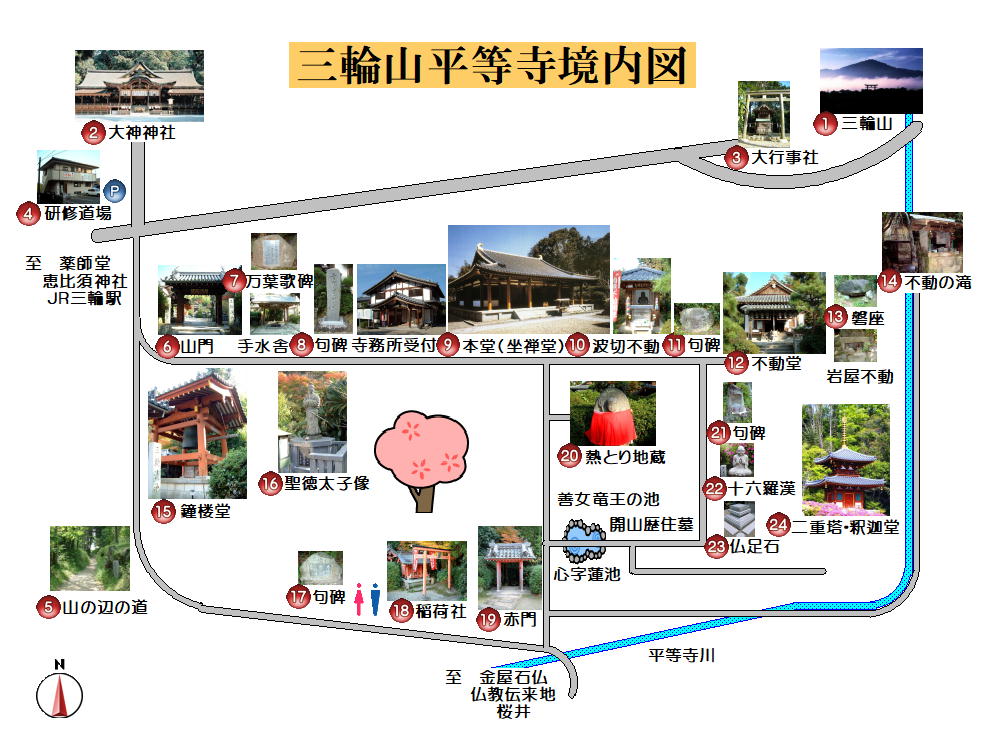
①三輪山 古来 、大物主大神が鎮まる神の山として信仰されている。御諸山(みもろやま)、 美和山、三諸岳(みもろだけ)
②大神神社 本殿は設けずに三ツ鳥居を通し三輪山を拝するという原初の神祀りの様を伝える我が国最古の神社のひとつ。
③大行事社 三輪山一山の年間の行事等のとりきめをした社で、元恵比須である。
④平等寺研修道場 いじめに負けない強い心と身体をつくる実践空手の道場。
⑤山の辺の道 三輪から奈良に通じる歴史上の記録では日本最古の道。
⑥山門 旧平等寺の唯一の建造物。
⑦万葉歌碑 「わが衣 色に染めなむ うまさけ 三室の山は もみぢしにけり」 万葉集巻7-1094 柿本人麻呂
⑧句碑 「青嵐や 無一物中 無盡蔵」 池田栄三郎氏
⑨本堂 1987(昭和62)年再建され、聖徳太子の御自作と伝えられる本尊十一面観世音菩薩はじめ薬師如来、阿弥陀如来、地蔵菩薩、聖徳太子像をまつる。
⑩波切堂 弘法大師の信仰された波切不動明王をまつる。
⑪句碑 「春蝉や 佛足の相の 石の上」 遣迎寺 武田無涯子
⑫不動堂 中央に弘法大師御自作と伝えられる三輪不動尊、右に役行者、左に理源大師をまつる。
⑬磐座 「影向石」神のよりしろとされた岩。三輪明神が貴女の姿になってこの石上に現れ、慶圓上人と問答をなされたと伝えられる。現在の場所へは当時地元で一番の力持ち、松田楢さんが運んだと伝えられる。
⑭不動の滝 昔より大峰山に登る行者が修行された行滝で、たらたら不動尊をまつる。
⑮鐘桜堂 1987(昭和62)年再建された。人間国宝香取正彦氏に指導をうけ、富山の老子製作所で鋳造された。
⑯聖徳太子像 この国の平和を三輪明神に祈願してこの寺を開かれた開基開山聖徳太子をまつる。
⑰句碑 「参禅の 寺を出づれば 後の月」 大谷しづこ
⑱稲荷社 伏見稲荷、豊川稲荷、孫太郎稲荷の三社をまつる。
⑲赤門 かつては重層の門であったが1976(昭和51)年現住職が手作りで建立した門。
⑳熱とり地蔵 吉野町時代の僧善教が大和の国の熱病平癒のために彫られた地蔵尊。
㉑歌碑 「三輪山の みねにゆきかふ 雲をみつつ われは一生を 大和に経たり」 角前あい
㉒十六羅漢 2010(平成22)年4月に鎌倉の寺尾家から寄贈いただいた16人の大阿羅漢。
㉓仏足石 平等寺に伝わる仏足石の複製。お釈迦さま亡き後、ストゥーパ(塔)と仏足石が信仰の中心でした。
㉔二重塔釈迦堂 2004(平成16)年に800年ぶりに再建され中央に生身釈迦像、平等寺仏足石、Dharmarajika寺院(Bangladesh)伝来の仏舎利をまつる。周りを十六羅漢像が囲む。
拝観時間 6:00~17:00 ※本堂拝観は要予約
Overview of Sacred Sites and Monuments within the Temple Precincts
1. Mount Miwa (Miwa-san)Since ancient times, this mountain has been worshiped
as a sacred hill where the great deity Omononushi-no-Okami resides. It
is also historically referred to as Mount Mimoro (Mimoroyama), Mount Miwa
(Miwayama), or Mount Mimoro (Mimorodake).
2. Omiwa Shrine (Omiwa Jinja)One of Japan's oldest Shinto shrines, it preserves
the most primitive form of nature worship. The shrine has no Main Hall
(Honden); instead, practitioners worship Mount Miwa directly through the
sacred triple torii gate (Mitsu-Torii).
3. Daigyoji Shrine (Daigyoji-sha)Originally dedicated to Ebisu (the deity
of wealth), this shrine historically served as the administrative site
where yearly events and regulations for the entire Mount Miwa temple-shrine
complex were decided.
4. Byodo-ji Training Dojo (Byodo-ji Kenshu Dojo)A dedicated training hall
for practical karate, aimed at cultivating a strong mind and body capable
of overcoming bullying and hardship.
5. Yamanobe-no-Michi TrailThe oldest road recorded in Japanese history,
running from Miwa all the way to Nara.
6. Sanmon Gate (Mountain Gate)The only surviving architectural structure
from the original, pre-Meiji Byodo-ji Temple.
7. Manyoshu Poem Monument (Manyo Kahi)A stone monument inscribed with a
poem by the famous court poet Kakinomoto no Hitomaro (from Volume 7-1094
of the Manyoshu):"I shall dye my robes in its brilliant colors, for
the sacred Mount Mimoro, renowned for its fine sake, has turned completely
to autumn maple leaves."
8. Haiku Monument (Kuhi)A stone monument inscribed with a haiku by Eizaburo
Ikeda:"The fresh summer breeze blows through; inside absolute nothingness
lies an inexhaustible treasure."
9. Main Hall (Hondo)Rebuilt in 1987, this hall enshrines the hidden principal
image of the Eleven-Headed Kannon Bodhisattva (said to have been hand-carved
by Prince Shotoku), alongside Yakushi Nyorai (the Medicine Buddha), Amida
Nyorai (the Buddha of Infinite Light), Jizo Bodhisattva, and a statue of
Prince Shotoku.
10. Namikiri-do HallA hall dedicated to Namikiri Fudo Myoo (the wave-cutting
wrathful deity), an object of deep devotion for the great monk Kobo Daishi
(Kukai).
11. Haiku Monument (Kuhi)A stone monument inscribed with a haiku by Mugaishi
Takeda from Rengei-ji Temple:"Spring cicadas buzz over the sacred
stone bearing the footprints of the Buddha."
12. Fudo-do HallThe center of this hall enshrines the Miwa Fudo Myoo (said
to have been carved by Kobo Daishi). It is flanked by En no Gyoja (the
founder of Shugendo) on the right and Rigen Daishi (the founder of the
Daigo lineage) on the left.
13. Iwakura Sacred Rock ("Yogo-ishi")A sacred rock believed to
be a vessel (Yorishiro) for divine spirits. Legend states that the Miwa
Deity appeared on this rock in the form of a noble woman to engage in a
spiritual dialogue with the restorer, Keien Shonin. It is said that Nara
Matsuda, historically famed as the strongest man in the local area, carried
this heavy stone to its current location.
14. Fudo Waterfall (Fudo no Taki)A sacred waterfall used since ancient
times for ascetic water purification rituals by mountain monks (Gyoja)
before ascending Mount Omine. It enshrines the Taratara Fudo Myoo deity.
15. Bell Tower (Shorodo)Rebuilt in 1987. The temple bell was cast at the
famous Oigo Foundry in Toyama Prefecture under the artistic guidance of
Masahiko Katori, a Living National Treasure of Japan.
16. Statue of Prince Shotoku (Shotoku Taishi Zo)A statue dedicated to the
founder of the temple, Prince Shotoku, who established this sacred site
to pray to the Miwa Deity for lasting national peace.
17. Haiku Monument (Kuhi)A stone monument inscribed with a haiku by Shizuko
Otani:"As I step out of the Zen meditation temple, the late autumn
moon greets me."
18. Inari Shrine (Inari-sha)A small Shinto shrine enshrining three protective
fox deities: Fushimi Inari, Toyokawa Inari, and Magotaro Inari.
19. Akamon (Red Gate)Originally a grand, two-storied gate, the current
single-level structure was built by hand by the current chief priest in
1976.
20. Netsutori Jizo (Fever-Relieving Jizo)A statue of Jizo Bodhisattva carved
by the monk Zenkyo during the Yoshino-cho period, crafted specifically
to pray for the eradication of epidemic fevers in Yamato Province.
21. Poem Monument (Kahi)A stone monument inscribed with a tanka poem by
Ai Kakumae:"Gazing at the drifting clouds that pass over the peak
of Mount Miwa, I have spent the entirety of my life here in the land of
Yamato."
22. The Sixteen Arhats (Juroku Rakan)A group of 16 statues representing
the great Arhats (enlightened disciples of the Buddha), donated to the
temple by the Terao family of Kamakura in April 2010.
23. Buddha’s Footprint Stone (Bussokuseki)A replica of the ancient Buddha's
footprint stone passed down through the history of Byodo-ji. Following
the passing of Shakyamuni Buddha, early followers used stupas and these
footprints as the central focuses of their faith before human statues were
made.
24. Two-Story Pagoda / Shaka-do Hall (Niju-no-to Shakado)Rebuilt in 2004
for the first time in 800 years. The center enshrines a lifelike statue
of Shakyamuni Buddha, the Byodo-ji Buddha's footprint stone, and sacred
Buddha relics (Busshari) brought from the ancient Dharmarajika Temple in
Bangladesh. The central images are surrounded by statues of the Sixteen
Arhats.
Opening Hours: 6:00 AM – 5:00 PM
Note: Prior reservations are strictly required to view the interior of
the Main Hall (Hondo).